

The logistics industry has undergone a massive digital transformation over the past few years. Businesses now rely on on-demand logistics apps to streamline deliveries, improve fleet management, optimize routes, and provide real-time tracking for customers. Whether you're a startup planning a logistics platform or an enterprise modernizing your transportation network, understanding the on-demand logistics app development cost is crucial before investing.
The cost of developing a logistics application depends on multiple factors, including the complexity of features, platform selection, technology stack, integrations, UI/UX design, and the development team's expertise. Partnering with an experienced logistics app development company can help you accurately estimate costs, choose the right technology, and build a scalable solution tailored to your business needs.In this guide, we explore every cost-driving factor, pricing estimates, development stages, hidden expenses, and practical ways to optimize your budget while building a scalable logistics solution.
What Is an On-Demand Logistics App?
An on-demand logistics app is a digital platform that enables businesses to manage transportation, deliveries, warehouses, drivers, customers, and shipments through a centralized system. These applications automate logistics operations while providing complete visibility into the supply chain.
Modern logistics applications typically include:
- Real-time shipment tracking
- GPS-enabled navigation
- Driver management
- Route optimization
- Digital proof of delivery
- Inventory synchronization
- Fleet monitoring
- Automated dispatch
- Customer notifications
- Online payments
- Analytics dashboards
These solutions improve operational efficiency, reduce transportation costs, and enhance customer satisfaction.
Read More: Avoid These 8 Costly Logistics App Development Mistakes Before You Start
Average On-Demand Logistics App Development Cost
The overall development cost varies according to business requirements.
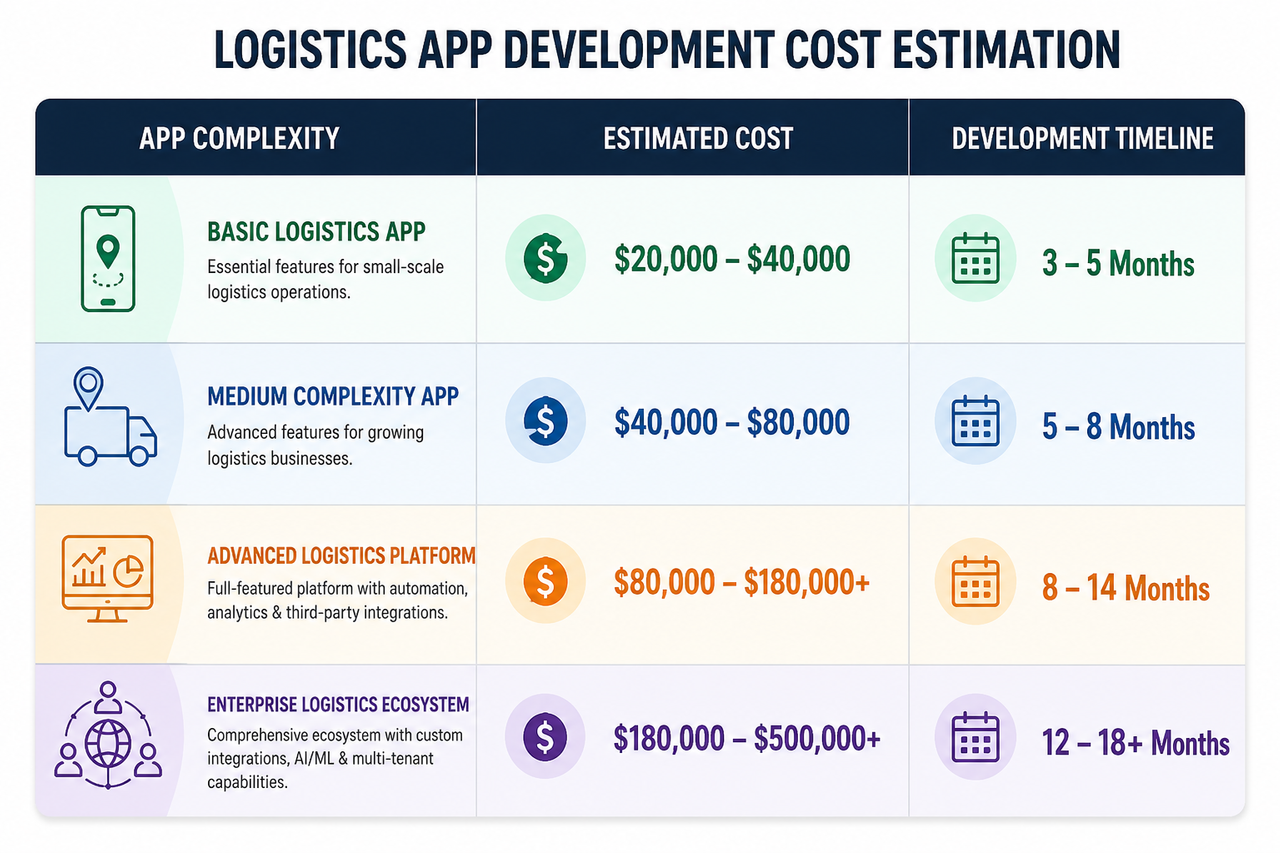
These estimates include planning, UI/UX design, frontend development, backend architecture, APIs, testing, deployment, and project management.
Key Factors That Affect Logistics App Development Cost
1. Application Complexity
The biggest pricing factor is the application's complexity.
A simple logistics application includes shipment booking, order management, GPS tracking, and notifications.
A medium-level solution may add:
- Driver allocation
- Route optimization
- Payment gateway
- Customer portal
- Admin dashboard
An enterprise-grade logistics platform may include:
- AI route optimization
- Predictive analytics
- IoT integration
- Warehouse automation
- Multi-location management
- ERP integration
- CRM synchronization
- Blockchain shipment verification
Every additional feature increases development time and overall investment.
2. Number of User Panels
Most logistics platforms require multiple applications.
Common user modules include:
Customer App
Customers can:
- Book shipments
- Track deliveries
- View order history
- Make payments
- Receive notifications
- Contact support
Driver App
Drivers can:
- Accept delivery requests
- Navigate optimized routes
- Update delivery status
- Upload proof of delivery
- Manage schedules
Admin Dashboard
Administrators monitor:
- Fleet performance
- Drivers
- Orders
- Customers
- Payments
- Analytics
- Reports
Developing multiple interfaces significantly affects project costs.
3. Platform Selection
The platform you choose directly impacts development expenses.
Android App
Ideal for reaching a broader user base.
iOS App
Preferred for premium users and enterprise clients.
Cross-Platform Development
Using technologies like Flutter or React Native reduces costs by sharing code across Android and iOS.
Web Dashboard
Required for logistics managers, dispatchers, and administrators.
Supporting all platforms requires additional development resources.
Essential Features That Influence Development Cost
User Registration
- Email login
- Phone authentication
- Social login
- OTP verification
Estimated Cost:
$1,000 – $2,500
Shipment Booking
Users should be able to:
- Schedule deliveries
- Select pickup locations
- Enter destination details
- Choose delivery type
Estimated Cost:
$2,000 – $5,000
Real-Time GPS Tracking
One of the most important logistics features.
Includes:
- Live vehicle tracking
- ETA calculation
- Route visualization
- Delivery status
Estimated Cost:
$5,000 – $12,000
Route Optimization
AI-powered route optimization helps:
- Reduce fuel costs
- Improve delivery speed
- Avoid traffic congestion
Estimated Cost:
$6,000 – $15,000
Push Notifications
Automatic alerts for:
- Shipment updates
- Driver arrival
- Payment confirmations
- Delivery completion
Estimated Cost:
$1,000 – $3,000
Payment Gateway Integration
Supports:
- Credit cards
- Digital wallets
- Net banking
- Business invoicing
Estimated Cost:
$2,000 – $5,000
Ratings and Reviews
Customers can review:
- Drivers
- Delivery quality
- Overall experience
Estimated Cost:
$1,000 – $2,500
Analytics Dashboard
Provides insights into:
- Revenue
- Deliveries
- Driver productivity
- Customer behavior
- Fleet performance
Estimated Cost:
$5,000 – $12,000
Advanced Features That Increase Development Cost
Businesses looking for competitive advantages often integrate advanced technologies.
These include:
Artificial Intelligence
AI helps optimize:
- Delivery schedules
- Route planning
- Demand forecasting
- Fleet utilization
Machine Learning
ML enables:
- Predictive maintenance
- Dynamic pricing
- Customer behavior analysis
Internet of Things (IoT)
IoT devices monitor:
- Vehicle health
- Fuel consumption
- Cargo temperature
- Driver behavior
Blockchain
Blockchain improves:
- Shipment transparency
- Secure documentation
- Smart contracts
- Fraud prevention
Warehouse Automation
Supports:
- Inventory tracking
- Barcode scanning
- RFID integration
- Smart storage
These technologies significantly enhance the platform but require larger development budgets.
Development Team Cost Breakdown
A complete logistics application typically requires:
Team Member Role
Business Analyst - Requirement gathering
Project Manager - Project coordination
UI/UX Designer - User interface design
Frontend Developer - Mobile application
Backend Developer - Server development
QA Engineer - Testing
DevOps Engineer - Deployment
Database Engineer - Database architecture
The larger the development team, the higher the project investment.
Technology Stack Used in Logistics App Development
A modern logistics solution commonly uses:
Frontend
- Flutter
- React Native
- Swift
- Kotlin
Backend
- Node.js
- Python
- .NET
- Java
Database
- PostgreSQL
- MongoDB
- MySQL
Cloud Platforms
- AWS
- Microsoft Azure
- Google Cloud
Maps and Navigation
- Google Maps API
- Mapbox
Notifications
- Firebase Cloud Messaging
Payment Integration
- Stripe
- PayPal
- Razorpay
Technology choices directly influence scalability, performance, and maintenance costs.
Third-Party API Integration Costs
Many logistics applications depend on external APIs.
Common integrations include:
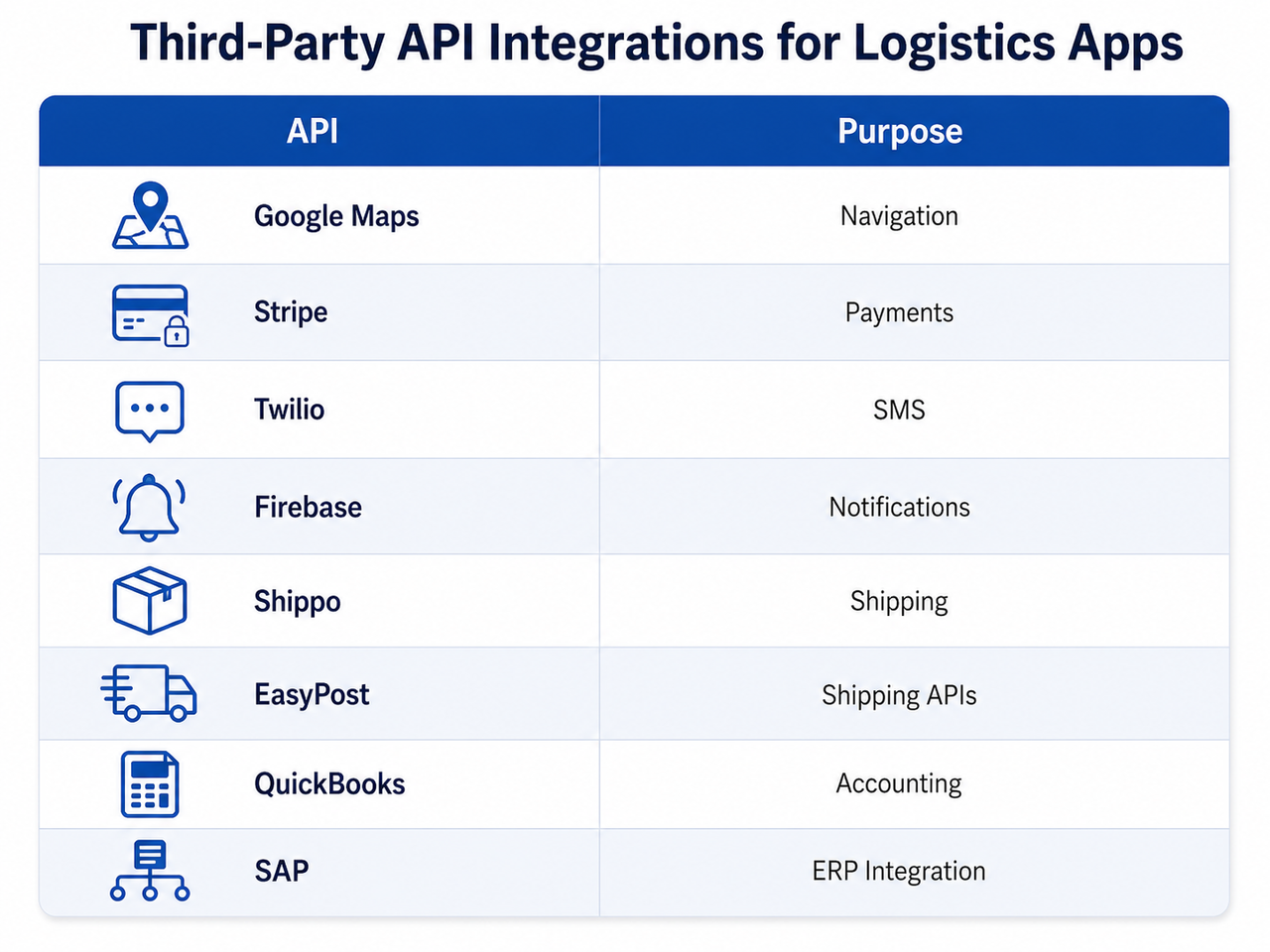
API licensing fees should be considered in the project budget.
Hidden Costs of Logistics App Development
Businesses often overlook ongoing expenses.
These include:
Cloud Hosting
Monthly server costs increase with user growth.
App Maintenance
Regular updates include:
- Bug fixes
- Security patches
- OS compatibility
- Performance improvements
Annual maintenance usually costs 15–20% of the initial development budget.
Security Compliance
Security investments include:
- SSL encryption
- Data protection
- Penetration testing
- GDPR compliance
- Multi-factor authentication
Scalability
Future expansion may require:
- Additional servers
- Database optimization
- CDN implementation
- Load balancing
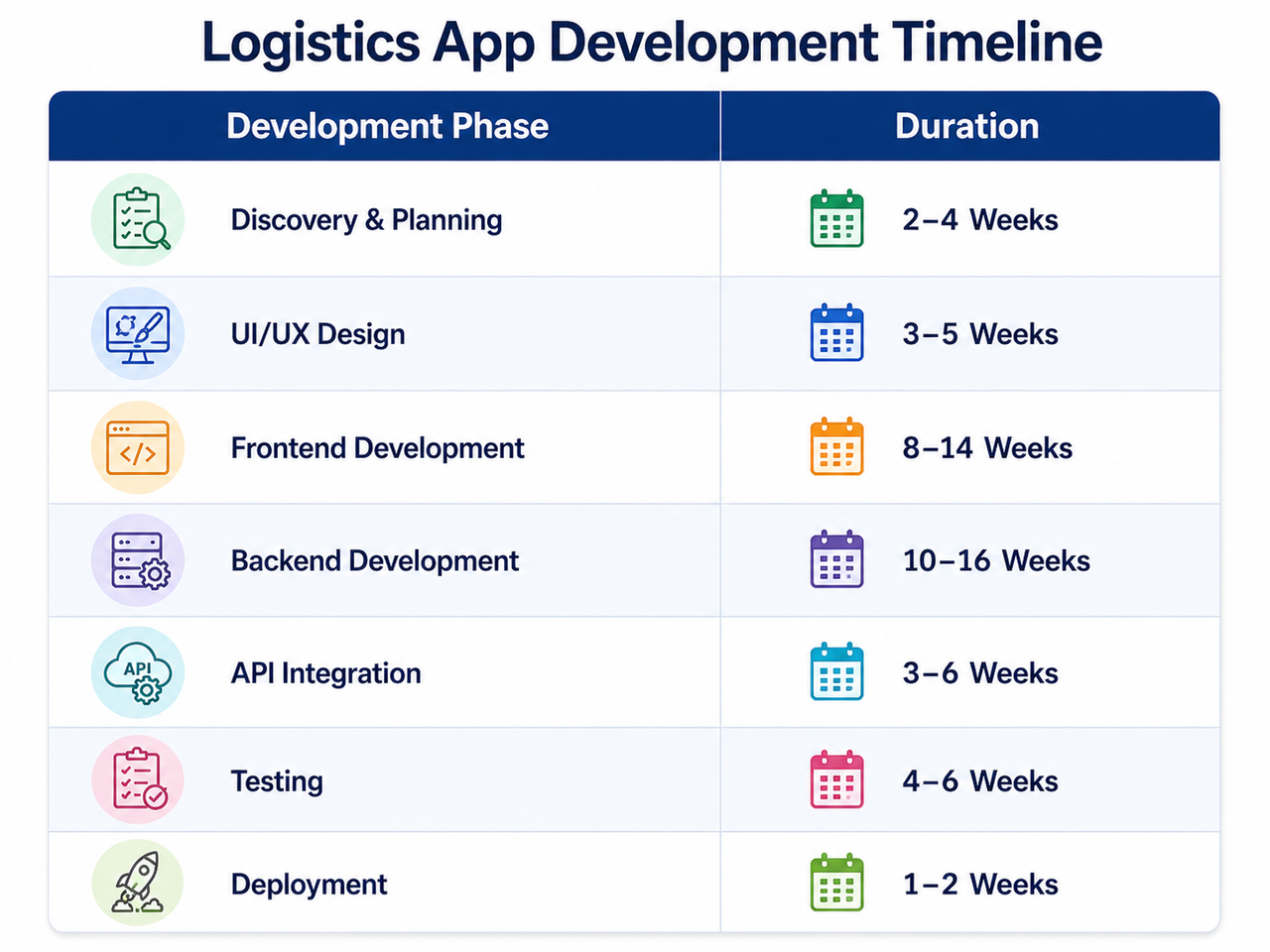
Development Timeline
A typical logistics application follows this schedule:
How to Reduce Logistics App Development Costs
Businesses can optimize their investment through strategic planning.
Effective cost-saving strategies include:
- Prioritize an MVP before building advanced features.
- Choose cross-platform development to reduce duplicate work.
- Use scalable cloud infrastructure.
- Integrate reliable third-party services instead of building everything from scratch.
- Define project requirements clearly before development begins.
- Automate testing where possible.
- Build modular architecture for future enhancements.
- Partner with an experienced logistics software development company to minimize costly revisions.
Benefits of Investing in an On-Demand Logistics App
Developing a logistics application offers measurable business advantages.
Key benefits include:
- Faster deliveries
- Lower operational costs
- Better fleet utilization
- Improved customer satisfaction
- Real-time shipment visibility
- Automated dispatch management
- Reduced manual errors
- Increased driver productivity
- Enhanced supply chain transparency
- Data-driven decision-making
- Scalable business operations
- Higher revenue opportunities
These benefits often provide long-term returns that outweigh the initial development investment.
Why Build an MVP Before a Full Logistics Platform?
Launching a Minimum Viable Product (MVP) is a practical way to validate your logistics solution before committing to a large-scale investment. An MVP focuses on the core functionality—such as shipment booking, GPS tracking, driver assignment, and delivery status updates—allowing businesses to gather real user feedback and refine the platform based on actual market needs.
Benefits of starting with an MVP include:
- Lower initial development costs
- Faster time-to-market
- Early customer validation
- Reduced business risk
- Easier feature prioritization
- Better scalability planning
Once the MVP proves successful, advanced capabilities like AI-powered route optimization, warehouse automation, predictive analytics, IoT tracking, and enterprise integrations can be introduced through phased updates.
Conclusion
The cost of on-demand logistics app development depends on your business goals, feature requirements, technology stack, and the overall complexity of the solution. A basic application may require an investment of $20,000–$40,000, while enterprise-grade logistics platforms with AI, IoT, advanced analytics, and ERP integrations can exceed $180,000.
A well-planned logistics application delivers far more than operational convenience. It improves delivery efficiency, enhances customer experiences, streamlines fleet management, and creates a scalable digital foundation for long-term business growth. By carefully defining project requirements, prioritizing essential features, and choosing an experienced development partner, businesses can maximize return on investment while building a secure, future-ready logistics platform that adapts to evolving market demands.
Frequently Asked Questions (FAQs)
1. How much does it cost to develop an on-demand logistics app?
The development cost typically ranges from $20,000 for a basic solution to $500,000 or more for a fully customized enterprise logistics platform with advanced features and integrations.
2. What factors have the biggest impact on logistics app development costs?
Major cost factors include feature complexity, supported platforms, UI/UX design, third-party integrations, AI or IoT functionality, cloud infrastructure, security requirements, and ongoing maintenance.
3. How long does it take to build a logistics application?
A basic MVP can be completed in 3–5 months, while a comprehensive enterprise solution generally requires 8–18 months, depending on project scope.
4. Is cross-platform development more cost-effective?
Yes. Cross-platform frameworks such as Flutter or React Native allow developers to maintain a shared codebase for Android and iOS, reducing development time and overall costs while ensuring consistent performance.
5. What ongoing costs should businesses consider after launch?
Post-launch expenses include cloud hosting, maintenance, security updates, API subscriptions, performance monitoring, feature enhancements, technical support, and operating system compatibility updates.


